
Courtesy of The Embassy of the Repbulic of Türkiye
The story begins in 1936, when the second Turkish Ambassador to the United States, Ambassador Münir Ertegün, first moved into the current Residence of the Turkish Ambassador with his wife, Emine, his two sons, Ahmet and Nesuhi, their daughter, Selma, and their collection of 25,000 jazz and blues records.
Having fallen in love with jazz at a young age, the Ertegün brothers became enamored with DC’s thriving music scene – yet repulsed by the strict segregation laws affecting the city’s music venues and social gatherings.
Ahmet, Nesuhi, and their father decided to stand up and make a change in the face of segregation. They began hosting jam sessions at the Ambassador’s Residence, opening the home to Black and white musicians to perform for integrated audiences. Their live Sunday music salons, which featured renowned artists like Duke Ellington and Lester Young, shocked much of Washington’s elite class. When prominent figures got wind of these sessions and complained about Black guests not using the back door of the Residence, Ambassador Ertegün informed them that in Turkish culture, guests always enter through the front door.
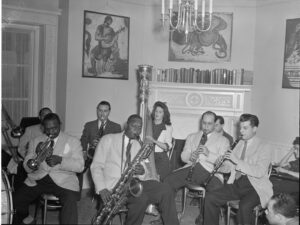
The Ertegün brothers both pursued their passion and continued working with great musicians who shaped the genre of jazz. Ahmet went on to co-found Atlantic Records in 1947, where Nesuhi joined as a producer in 1956, and the label became home to some of the most recognized names of all time, including Ray Charles, Charles Mingus, Aretha Franklin, and John Coltrane.
Since 2011, Turkish Embassy has been hosting jazz concert series as an homage to Ahmet and Nesuhi Ertegün brothers and their place in history of jazz and cultural diplomacy.
Header image and photograph accompanying text: Photo by William Gottlieb, Turkish Embassy, Late 1930s. William P. Gottlieb Collection, Library of Congress.